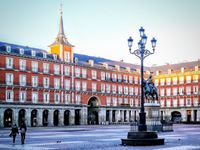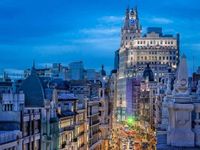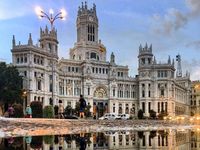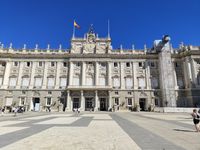
Madrid is Spain's capital and largest city, with major cultural and architectural heritage, world-class art museums, broad avenues and plazas, strong football traditions, and a nightlife known to run until dawn.
Essential facts
- Population
- 3,506,730
- As of 2025
- Currency
- Euro (EUR)
- Spoken Languages
- Spanish
- Area
- 604.5 km²
- Population density
- 5,801 / km²
Show all factsHide fact details
Administration
- Country
- Spain
- Administrative Region
- Community of Madrid
- Head of Government
- José Luis Martínez-Almeida
- Administrative Districts
- 17
Geography & Practical Information
- Elevation
- 663 m
- Postal code
- 28001–28081
- Calling code
- 34
- Vehicle registration
- M
- Official website
- www.madrid.es
Districts
An overview of the districts of Madrid – with local character, practical facts, and detailed travel guides.
Arganzuela
Carabanchel
Castellana
Centro
Chamberí
Ciudad Lineal
Fuencarral-El Pardo
Hortaleza
Latina
Moncloa-Aravaca
Moratalaz
Puente de Vallecas
Retiro
Usera
Vicálvaro
Villa de Vallecas
Villaverde
Climate through the year
Monthly averages for 2016–2025
Sources: Open-Meteo using Copernicus Climate Change Service ERA5
Highlights
Three Cities in One Day: Segovia, Avila and Toledo from Madrid
BookableJoin this 11-hour trip from Madrid and visit three cities in just one day.
Toledo Half- or Full-Day Tour with Optional Lunch from Madrid
BookableImmerse yourself in its history and discover a perfect blend of Arab, Jewish, and Christian culture.
Madrid Tapas & Wine Tasting Food Tour – Local Bars in a Small Group
BookableDiscover the authentic flavors of Madrid on this 3-hour small-group Tapas & Wine Food Tour through the historic city center.
Madrid Tapas & Taverns: Food & History in a Small Group
BookableMadrid's history comes alive through food and fascinating stories on this unique tapas crawl.
Madrid: Guided Tour of the Royal Palace with Skip-the-Line Ticket
BookableReady to immerse yourself in the opulent world of the Royal Palace of Madrid?
Flamenco show at Corral de la Moreria Madrid with optional dinner
BookableFeel the feverish heat of traditional Spanish dance at a flamenco show in one of the country's most prestigious tablaos (flamenco venues).
Madrid Old Town & Royal Palace – No Queues
BookableThe tour begins at the door of the Fun and Tickets office at Calle Coloreros, 2, with a guided tour of the Royal Palace.
Flamenco Show & Special Menu at Torres Bermejas in Madrid
BookableTorres Bermejas, opened in 1960, is the world's most important and unique flamenco show.
Destination guide
Orientation
Most of the best-known visitor areas lie in the city centre, including Puerta del Sol, Plaza Mayor, Palacio Real and Plaza de Colón. Major streets that help with orientation are...
Orientation
Most of the best-known visitor areas lie in the city centre, including Puerta del Sol, Plaza Mayor, Palacio Real and Plaza de Colón. Major streets that help with orientation are...
Most of the best-known visitor areas lie in the city centre, including Puerta del Sol, Plaza Mayor, Palacio Real and Plaza de Colón. Major streets that help with orientation are Gran Vía, Alcalá Street and Paseo de la Castellana.
Madrid sits northeast of the geographical centre of the Iberian Peninsula on the Castilian plateau. The city has a continental climate: hot, dry summers; cold winters with night frosts and occasional snow; and mild spring and autumn weather.
The most useful visiting months are generally April, May, June, September and October.
- Use the central plazas and major avenues as reference points.
- Expect weather extremes and pack accordingly.
- Visit in spring or autumn for the most comfortable conditions.
- Do not rely on winter for mild weather.
- Do not expect heavy rainfall in summer or winter.
- location
- Northeast of the geographical centre of the Iberian Peninsula
- terrain
- Castilian plateau (Meseta central)
- best_seasons
- Spring and autumn, especially April, May, June, September and October
Getting there
Madrid-Barajas Airport handles all commercial flights to the city and is about 13 km northeast of the centre. The airport has two separated terminal complexes: T1/T2/T3 and T4/T...
Getting there
Madrid-Barajas Airport handles all commercial flights to the city and is about 13 km northeast of the centre. The airport has two separated terminal complexes: T1/T2/T3 and T4/T...
Madrid-Barajas Airport handles all commercial flights to the city and is about 13 km northeast of the centre. The airport has two separated terminal complexes: T1/T2/T3 and T4/T4S. A free shuttle bus links the complexes landside, and the metro, Cercanías trains and airport buses connect the airport with the city.
By train, Madrid has two main stations: Atocha and Chamartín. Atocha serves many southern and eastern routes, while Chamartín has more direct services to north-west cities such as Bilbao, León, Santiago and Salamanca. By bus, long-distance routes use Estación Sur or Avenida de América.
- Allow extra time for airport transfers and station security.
- Check whether a train or bus departs from Atocha, Chamartín, Estación Sur or Avenida de América.
- Use the free shuttle for terminal transfers at the airport.
- Do not assume all airport transfers use the same terminal complex.
- Do not leave rail security checks or station transfers to the last minute.
- airport
- Madrid-Barajas Airport (MAD)
- airport_distance
- 13 km northeast of the city
- main_train_stations
- Atocha and Chamartín
- main_bus_stations
- Estación Sur and Avenida de América
Getting around
Madrid has a large integrated public transport network of Metro and buses, with the same tickets used across both. The Metro is extensive, relatively inexpensive and generally r...
Getting around
Madrid has a large integrated public transport network of Metro and buses, with the same tickets used across both. The Metro is extensive, relatively inexpensive and generally r...
Madrid has a large integrated public transport network of Metro and buses, with the same tickets used across both. The Metro is extensive, relatively inexpensive and generally runs from about 06:00 to 01:30.
Contactless bank card or phone payment is supported, and a reloadable Multi Card is required if no paper ticket is already held. For central travel, public transport is usually the best option. Taxis are plentiful, though they may be harder to find late on weekend nights or in rain.
Driving in central Madrid is often difficult because of traffic, narrow streets, congestion and limited parking, so a car is generally unnecessary inside the centre.
- Use Metro and buses for most central journeys.
- Carry the names and addresses of destinations in Spanish for taxi rides.
- Plan extra time when driving or transferring underground in the centre.
- Do not expect central driving and parking to be easy.
- Do not leave valuables visible in taxis or on public transport.
- metro_hours
- About 06:00-01:30 daily
- single_fare_zone_a
- €1.50
- multi_card
- €2.50 reloadable contactless card
- airport_metro_supplement
- €3
Sights
Madrid's strongest sightseeing cluster is the museum triangle along Paseo del Prado, home to the Prado, Thyssen-Bornemisza and Reina Sofía.
Sights
Madrid's strongest sightseeing cluster is the museum triangle along Paseo del Prado, home to the Prado, Thyssen-Bornemisza and Reina Sofía.
- Prioritise the museum triangle if art is a main interest.
- Use Retiro Park for a break from the city streets.
- Combine nearby central landmarks on foot.
- Do not try to cover every major sight in one day.
- Do not overlook the smaller museums near the main art district.
Things to do
Madrid offers strong sports and nightlife options. Football is the city's best-known sport, with Real Madrid and Atlético de Madrid as the major clubs and matches often played a...
Things to do
Madrid offers strong sports and nightlife options. Football is the city's best-known sport, with Real Madrid and Atlético de Madrid as the major clubs and matches often played a...
Madrid offers strong sports and nightlife options. Football is the city's best-known sport, with Real Madrid and Atlético de Madrid as the major clubs and matches often played at Bernabéu and Metropolitano. Basketball, rugby and handball also have notable local teams and venues.
Cultural options include flamenco, opera, orchestral performances and cinemas showing original-language films marked V.O. or VOSE. The city's nightlife is spread across several distinct districts, including La Latina, Barrio de las Letras, Chueca, Malasaña and Gran Vía, each with a different crowd and music profile.
- Pick nightlife areas by music style and crowd rather than only by distance.
- Check original-language film labels if wanting English or subtitled screenings.
- Book or arrive early for major football matches if attending.
- Do not expect clubs to be busy before midnight.
- Do not underestimate late-night transport and taxi demand after going out.
Food and drink
Madrid's dining rhythm is late. Lunch commonly runs from about 13:00 to 15:30, while dinner usually starts around 20:00 or later; many bars and mesones stay open all day and are...
Food and drink
Madrid's dining rhythm is late. Lunch commonly runs from about 13:00 to 15:30, while dinner usually starts around 20:00 or later; many bars and mesones stay open all day and are...
Madrid's dining rhythm is late. Lunch commonly runs from about 13:00 to 15:30, while dinner usually starts around 20:00 or later; many bars and mesones stay open all day and are better for flexible eating. In tapas bars, drinks may come with free food, and orders are often made as a ración, media ración or tapa.
Local specialties include cocido madrileño, callos a la madrileña, oreja de cerdo, sopa de ajo, gallinejas and entresijos. Madrid is also known for high-quality seafood and meat products, though seafood can be expensive.
For paella, tourist-oriented places around Sol and Plaza Mayor are often poor choices; La Latina, especially Calle Cava Baja, is a better area for tapas and more reliable food.
- Eat according to local hours if using restaurants.
- Look for tapas streets and bars in La Latina and Barrio de las Letras.
- Consider seafood and meat specialties if seeking local flavours.
- Do not rely on tourist paella offers around Sol and Plaza Mayor.
- Do not assume dinner service starts early.
- dinner_start
- Usually 21:00-22:00
- lunch_hours
- Usually 13:00-15:30
- late_nightlife
- Bars may stay open until 05:00-07:00
Sleep
Staying in the historic centre is convenient, but nearby districts such as Malasaña, Chueca and Chamberí can offer lower rates while remaining close to the main sights. Apartmen...
Sleep
Staying in the historic centre is convenient, but nearby districts such as Malasaña, Chueca and Chamberí can offer lower rates while remaining close to the main sights. Apartmen...
Staying in the historic centre is convenient, but nearby districts such as Malasaña, Chueca and Chamberí can offer lower rates while remaining close to the main sights. Apartments can also be practical for families or small groups because they allow self-catering and often sit in residential neighbourhoods.
Hostels are available in the Sol area, Lavapiés and near Plaza de España. Budget hotels and B&Bs are common in Barrio de las Letras and Chueca, while mid-range hotels are concentrated around Barrio de las Letras, Sol and Paseo del Arte.
Higher-end hotels are most common in Salamanca, along Gran Vía, and in the historic centre.
- Choose a location based on noise tolerance as well as sight access.
- Consider apartments for longer stays or group travel.
- Check whether the hotel sits on a quiet street if sleep is important.
- Do not assume central nightlife areas are quiet at night.
- Do not ignore neighbourhood location when comparing prices.
- hostel_prices
- From about €8 for a dorm bed
- budget_double
- About €55-100
- mid_range
- About €60-150 per night
- splurge
- At least €90 per night
Shopping
The most convenient shopping for visitors is around Sol, especially Calle de Preciados and Calle del Carmen, where major high-street brands and department stores are concentrate...
Shopping
The most convenient shopping for visitors is around Sol, especially Calle de Preciados and Calle del Carmen, where major high-street brands and department stores are concentrate...
The most convenient shopping for visitors is around Sol, especially Calle de Preciados and Calle del Carmen, where major high-street brands and department stores are concentrated. For upscale shopping, Salamanca is the main district, centred on Calle Serrano and nearby streets.
Chueca and Calle Fuencarral are known for more avant-garde and trend-oriented shopping. Most stores accept major credit cards and foreign bank cards, but photo ID may be requested. El Corte Inglés is a major local department store chain and is especially prominent around Preciados and Plaza de Callao.
Markets are also worth looking for in the La Latina–Austrias and Retiro–Paseo del Arte areas.
- Use Sol for the most convenient central shopping.
- Go to Salamanca for higher-end brands.
- Carry photo ID when shopping with cards.
- Do not expect every shop to check signatures.
- Do not overlook department stores as practical fallback options.
Practical information
Madrid has 5G coverage from major Spanish carriers, and locutorios near tourist areas are inexpensive for calls and SIM-related help. Free English-language periodicals in bars a...
Practical information
Madrid has 5G coverage from major Spanish carriers, and locutorios near tourist areas are inexpensive for calls and SIM-related help. Free English-language periodicals in bars a...
Madrid has 5G coverage from major Spanish carriers, and locutorios near tourist areas are inexpensive for calls and SIM-related help. Free English-language periodicals in bars and restaurants can be useful for event information.
The city is very safe for a large European capital, but pickpocketing and scams remain common in busy places. Keep belongings secure on the Metro, at Atocha, in Puerta del Sol, around Gran Vía and in nightlife areas. Plaza Mayor and Puerta del Sol are also known for scams, and street vendors near Sol can be persistent.
- Keep bags and wallets under close control in crowded areas.
- Use 112 for police, medical or fire emergencies.
- Stay alert to distraction tactics, especially near transport hubs and famous squares.
- Do not leave phones or wallets on tables in bars and restaurants.
- Do not engage with unsolicited petitions, directions requests or massage offers if they feel suspicious.
- emergency_number
- 112
- network
- 5G from major Spanish carriers
Safety
Madrid is generally very safe for a major city, with visible policing and a strong street presence even at night. The main risks for visitors are nonviolent pickpocketing, night...
Safety
Madrid is generally very safe for a major city, with visible policing and a strong street presence even at night. The main risks for visitors are nonviolent pickpocketing, night...
Madrid is generally very safe for a major city, with visible policing and a strong street presence even at night. The main risks for visitors are nonviolent pickpocketing, nightlife-related theft and a few areas that feel rougher late at night.
Extra caution is advisable in Gran Vía, Puerta del Sol, Atocha station, the AZCA business district and some nightlife venues. Malasaña can attract seedy crowds late at night, and parts of the south and east are less comfortable after dark, although most places near metro stations remain safe.
Football match days can also bring tension around major rivalries.
- Watch bags, phones and wallets in crowds and on transit.
- Use well-lit, busy streets at night.
- Keep a close eye on drinks and valuables when going out.
- Do not leave valuables visible on tables or in open pockets.
- Do not assume all late-night areas are equally safe.
More about Madrid
Loading Wikipedia chapters…