Hamburg is the city with the largest port in Germany. After Berlin, it is the second-largest German city with almost 1.9 million inhabitants, located about 80 km from both the Baltic Sea and the North Sea, and at the mouth of the Alster and Bille into the Elbe.
Essential facts
- Population
- 1,910,160
- As of 2023-12-31
- Currency
- Euro (EUR)
- Spoken Languages
- German
- Area
- 755.1 km²
- Population density
- 2,530 / km²
Show all factsHide fact details
Administration
- Country
- Deutschland
- Official name
- Freie und Hansestadt Hamburg
- Head of Government
- Peter Tschentscher
- Legislative Body
- Hamburgische Bürgerschaft
- Administrative Districts
- 7
Geography & Practical Information
- Elevation
- 6 m
- Postal code
- 20095–21149, 22041–22769, 27499
- Calling code
- 49
- Vehicle registration
- HH
- ISO code
- DE-HH
- Time Zone
- Europe/Berlin
- Official website
- www.hamburg.de
Districts
An overview of the districts of Hamburg – with local character, practical facts, and detailed travel guides.
Climate through the year
Monthly averages for 2016–2025
Sources: Open-Meteo using Copernicus Climate Change Service ERA5
Destination guide
Orientation
Hamburg is divided into seven boroughs, each of which in turn contains several districts, totaling 104 Districts north of the Elbe: St. Pauli, Neustadt, Altstadt, Hafencity, St....
Orientation
Hamburg is divided into seven boroughs, each of which in turn contains several districts, totaling 104 Districts north of the Elbe: St. Pauli, Neustadt, Altstadt, Hafencity, St....
Districts
Hamburg is divided into seven boroughs, each of which in turn contains several districts, totaling 104
Hamburg-Mitte
Districts north of the Elbe: St. Pauli, Neustadt, Altstadt, Hafencity, St. Georg, Borgfelde, Hammerbrook, Hamm, Rothenburgsort, Horn, Billbrook und Billstedt.
Districts south of the Norderelbe: Finkenwerder, Waltershof, Steinwerder, Kleiner Grasbrook, Veddel und Wilhelmsburg.
District in the Elbe estuary, 110 km away: Neuwerk with its three North Sea islands Neuwerk, Scharhörn und Nigehörn.
Hamburg- Altona
Districts: Altona-Altstadt, Altona-Nord, Sternschanze, Bahrenfeld, Groß Flottbeck, Othmarschen, Ottensen, Blankenese, Iserbrook, Lurup, Nienstedten, Osdorf, Sülldorf, Rissen.
Hamburg- Eimsbüttel
Districts: Eidelstedt, Eimsbüttel, Harvestehude, Hoheluft-West, Lokstedt, Niendorf, Rotherbaum, Schnelsen, Stellingen.
Hamburg- Nord
Districts: Alsterdorf, Barmbek-Nord, Barmbek-Süd, Dulsberg, Eppendorf, Fuhlsbüttel, Groß Borstel, Hohenfelde, Hoheluft-Ost, Langenhorn, Ohlsdorf, Uhlenhorst, Winterhude.
Hamburg- Wandsbek
Districts: Bergstedt, Bramfeld, Duvenstedt, Eilbek, Farmsen-Berne, Hummelsbüttel, Jenfeld, Lemsahl-Mellingstedt, Marienthal, Poppenbüttel, Rahlstedt, Sasel, Steilshoop, Tonndorf, Volksdorf, Wandsbek, Wellingsbüttel, Wohldorf-Ohlstedt.
Hamburg- Bergedorf
Districts: Allermöhe, Altengamme, Bergedorf, Billwerder, Curslack, Kirchwerder, Lohbrügge, Moorfleet, Neuallermöhe, Neuengamme, Ochsenwerder, Reitbrook, Spadenland, Tatenberg.
Hamburg- Harburg
Districts: Altenwerder, Cranz, Eißendorf, Francop, Gut Moor, Harburg, Hausbruch, Heimfeld, Langenbek, Marmstorf, Moorburg, Neuenfelde, Neugraben-Fischbek, Neuland, Rönneburg, Sinstorf, Wilstorf. Areas of tourist interest
during the day: St. Pauli with the Landungsbrücken, Neustadt, Altstadt, Hafencity with the Speicherstadt
Around the Alster
Staircase Quarter: Blankenese − (Villas on the Elbe riverbank with great views)
in the evening and at night: St. Pauli with the Reeperbahn, Ottensen, Schanzenviertel, Karolinenviertel, St. Georg. Background
further articles on Hamburg
Hamburg - History
Hamburg - Museums
Old Town and New Town
Speicherstadt and Hafencity
St. Pauli - Landungsbrücken and Reeperbahn
St. Georg and eastern districts
Borough and District Altona
Borough and District Bergedorf
Borough and District Eimsbüttel
Borough and District Harburg
Borough and District Wandsbek
Hamburg Airport
Train Stations in Hamburg
Central Bus Station Hamburg History
See also Hamburg - History.
Approximately 1,200 years ago, the city's development began with the construction of a Saxon castle. In the 9th century, the Hammaburg, which gave Hamburg its name, was established in its place.
The present-day Old Town covers approximately the area that the medieval merchant and craft city of Hamburg occupied at the end of the 13th century. At that time, an estimated 5,000 people lived within the city walls; by 1691, there were already approximately 40,000.
From the year 1200 onwards, the Trostbrücke bridge over the Nikolaifleet connected the episcopal Old Town with the new merchant city.
Arrival
1 Hamburg Airport (Hamburg Airport Helmut Schmidt), Flughafenstr. 1 – 3, 22335 Hamburg. Hamburg Airport, located in the Fuhlsbüttel district in the north of the city, has two te...
Arrival
1 Hamburg Airport (Hamburg Airport Helmut Schmidt), Flughafenstr. 1 – 3, 22335 Hamburg. Hamburg Airport, located in the Fuhlsbüttel district in the north of the city, has two te...
By Plane
1 Hamburg Airport (Hamburg Airport Helmut Schmidt), Flughafenstr. 1 – 3, 22335 Hamburg. Hamburg Airport, located in the Fuhlsbüttel district in the north of the city, has two terminals completed in 1993 and 2005. You can get to the city center by S-Bahn (Line S1, which starts at the airport) or by night bus 606.
Attention: On the way to the airport, the S1 splits at Ohlsdorf; the front cars go to the airport, the rear cars go to Poppenbüttel! The 2 Uetersen/Heist Airfield for sport and business aviation is accessible via the / 18 Pinneberg-Süd and further via K 1 / L 105 / K 15 or directly via (approx. 35 km).
The 3 Hartenholm Airfield is a licensed airfield in the municipality of Hasenmoor in Schleswig-Holstein. It is licensed for aircraft up to 5,700 kg and helicopters up to 10,000 kg. Services: Aircraft maintenance services, sightseeing and charter flights, flight school, and skydiving. (approx. 52 km via )
- Hamburg Airport: Located in the Fuhlsbüttel district in the north of the city. Address: Flughafenstr. 1 – 3, 22335 Hamburg. Category: go/airport
By Train
Long-distance train stations
4 Hamburg Central Station, Hachmannplatz 16, 20099 Hamburg. Features: S-Bahn station, U-Bahn station.
5 Hamburg-Dammtor Station, Theodor-Heuss-Platz, 20354 Hamburg.
6 Hamburg-Altona Station, Scheel-Plessen-Str. 17, 22765 Hamburg. Features: free Wi-Fi, S-Bahn station.
7 Hamburg-Harburg Station, Hannoversche Str. 85, 21079 Hamburg. Features: free Wi-Fi, S-Bahn station.
8 Hamburg-Bergedorf Station, Weidenbaumsweg 14, 21029 Hamburg.
Hamburg is the central hub for long-distance and local transport in northern Germany. In addition to the Central Station, long-distance trains also stop at Hamburg-Dammtor and Hamburg-Altona Station; some long-distance trains also stop in the southern districts at Hamburg-Harburg and Hamburg-Bergedorf stations.
All S-Bahn and U-Bahn lines intersect at the Central Station. With up to 450,000 passengers and visitors per day, it is the busiest passenger station in Germany. Beneath its venerable, vast, curved glass roof are 12 tracks.
Regional and long-distance transport is handled on 4 platforms, 2 S-Bahn platforms (one of which is underground), and 4 U-Bahn platforms.
The HVV (Hamburg Transport Association) Information Center with the Tourist Information Center, the DB customer center, and many shops are located in the northern part, the "Wandelhalle". Altona is a terminus station with two underground S-Bahn platforms, where most S-Bahns intersect again.
Numerous shops are housed on the various floors, including shops for travel essentials and food outlets, as well as a supermarket also open on Sundays and an electronics superstore chain.
Mobility
Public transport in Hamburg is operated by the Hamburger Verkehrsverbund (HVV). The network extends beyond the borders of Hamburg and includes adjacent districts in Schleswig-Ho...
Mobility
Public transport in Hamburg is operated by the Hamburger Verkehrsverbund (HVV). The network extends beyond the borders of Hamburg and includes adjacent districts in Schleswig-Ho...
Public transport
Public transport in Hamburg is operated by the Hamburger Verkehrsverbund (HVV). The network extends beyond the borders of Hamburg and includes adjacent districts in Schleswig-Holstein and Niedersachsen.
In the inner city area, the network of public transport lines (metros, suburban trains, and buses) is very dense; in the outer city areas, due to Hamburg's extensive area, it is naturally somewhat sparser. The last tram ran in 1978 and was supposed to be reintroduced in 2014; the project was stopped in 2011.
3 suburban train lines meet at the main station and branch off parallel to the connecting line and the City Tunnel line. They meet again under Altona long-distance station. From there, 2 lines continue to Wedel and Pinneberg.
Together with the 4 metro lines, 112 bus lines, and a few ferry lines, public transport is covered. The 3 AKN suburban lines in the north do not run into the city center during the day.
The metro often runs above ground (hence the name 'elevated railway'), until at least 9:00 PM at 5-minute intervals. Worth seeing is the old section of the U3 from Rathaus to Landungsbrücken with views of the harbor.
The U4 line of the Hamburg Metro runs from Jungfernstieg with the three stations Überseequartier, Hafencity-Universität, and Elbbrücken into Hafencity.
Low-barrier access to the metros is indicated on the platform with a checkerboard pattern surface (usually in the middle of the platform) and on the vehicles with a small sticker on the corresponding doors.
The suburban trains and metros run all night on the nights before Saturday, Sunday, and public holidays. From Monday to Friday, rapid transit service ends around 12:30 AM. After that, 19 night bus lines run every 30 to 60 minutes until morning.
The Hamburger Verkehrsverbund HVV also includes regional trains and harbor ferries. The HVV's transport connections extend far into adjacent districts in Schleswig-Holstein and Niedersachsen; ticket prices here are tiered according to 'zones', even within the city.
EF The 6 harbor ferries can be used with regular tickets at no extra charge. Of particular tourist interest are lines 72 (Landungsbrücken - Elbphilharmonie), 62 (Landungsbrücken - Fischmarkt - Övelgönne - 1 Finkenwerder), and 64 (Finkenwerder - 2 Teufelsbrück).
These 3 lines also run on weekends and in winter, making interesting trips possible even in icy conditions. Bicycles are transported free of charge.
Under the name Metrobus (one- to two-digit line numbers), there exists, complementing the suburban train and metro network, a rapid transit-like, surcharge-free bus system, which connects the outskirts with the city center as well as offering direct cross-connections or partial ring lines (e.g., line 25).
Places of interest
2 TV Tower (officially: Heinrich-Hertz-Turm) would offer a fantastic panoramic view of the city from its observation deck and revolving restaurant. Unfortunately, both have been...
Places of interest
2 TV Tower (officially: Heinrich-Hertz-Turm) would offer a fantastic panoramic view of the city from its observation deck and revolving restaurant. Unfortunately, both have been...
Attractions
2 TV Tower (officially: Heinrich-Hertz-Turm) would offer a fantastic panoramic view of the city from its observation deck and revolving restaurant. Unfortunately, both have been closed since 2001. However, there are efforts to make both accessible to the public again.
Insiders expect that the start of the necessary renovation is not realistic before 2026 and will be completed at the earliest in the first half of 2031. Vorlage:Zukunft/In 5 Jahren Michel
1 St. Michael's Church (Michel) Hamburg's landmark is 132 meters high, having burned down multiple times and been rebuilt again and again. From the top, you have the most beautiful panoramic view of the city. The tower can be climbed by stairs or elevator.
Below lies the Neustadt, next to it the Altstadt, to the north the Alster, to the west St. Pauli, and to the south the Landungsbrücken and the large harbor.
St. Michael's Church (called "Michel" by Hamburgers) is one of Hamburg's main churches and the city's landmark. The Protestant church is the most significant Baroque building in Northern Germany.
Its interior holds 2500 seats. • Also worth seeing are the exhibition on the history of Hamburg's churches and the restoration of the Michel, as well as the church's crypt with the grave of Carl Philip Emanuel Bach. • Info: St. Michaelis
Open daily from May - Oct: 9:00 - 20:00, otherwise 10:00 - 18:00 • Subway: St. Pauli, Baumwall or S-Bahn: Stadthausbrücke Rathaus
The current monumental Town Hall building dates from 1887 and was built after the old Town Hall at Trostbrücke burned down in 1842.
The building was built in the Neo-Renaissance style. A popular photo motif is the 111 m wide facade with its 112 m high central tower, the tallest town hall tower in Germany.
The interior decoration is also magnificent, especially the Emperor's Hall, the Parliament Hall, and the Mayor's Hall with its huge fireplace. • Also worth seeing is the inner courtyard with the old stock exchange and the magnificent Hygieia Fountain. • The Town Hall itself can be visited almost daily with half-hourly guided tours from 10:00 to 15:00 (Sat 10:00-17:00, Sun 10:00-16:00), (ages 15+: €5, under 15 free). • [1] Alster
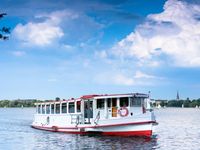
The Alster is just a small river 56 km long and flows through Hamburg's northeast and the city center. Before the Altstadt, it is dammed up as the 1 Außenalster and 2 Binnenalster. In the middle of the city lie two lakes, on which passenger ships sail and in summer weather, numerous sailboats glide on the water.
While the Elbchaussee may be more upscale and Blankenese the premier residential address, the Außenalster is the heart of the Hanseatic city. Around 1900, the wealthy bourgeoisie built their villas around the lake like a multi-row pearl necklace.
The most beautiful houses are the "Weiße Haus" (Hotel Atlantic), the former US Consulate, the Sloman Castle from 1848, the Budge Palais, and the Laeisz Villa. In an hour and a half, you can walk around the Außenalster.
The 4 Lombardsbrücke Lombardsbrücke separates the Außenalster and Binnenalster.
Things to do
Various providers offer different harbor tours. The biggest difference is usually – due to the size of the ships – where they go. Small launches also go into the Speicherstadt,...
Things to do
Various providers offer different harbor tours. The biggest difference is usually – due to the size of the ships – where they go. Small launches also go into the Speicherstadt,...
Harbor Tours...by Ship
Various providers offer different harbor tours. The biggest difference is usually – due to the size of the ships – where they go. Small launches also go into the Speicherstadt, while larger ones focus on the main harbor basins, which are nevertheless just as interesting.
* Prices range from €14 to €22 for 1 to 2 hours.
* HH Tourism: Harbor Tours The Hop-On Hop-Off launch tour by Maritime Circle Line with stops at harbor attractions
* Tour: €16.00 / Children €8.00
* The fare is valid for the entire round trip, regardless of how often the journey is interrupted.
Upon presentation of the Maritime Circle Line (MCL) ticket, you receive a discount on the respective admission price at various museums. With the HVV ticket, you can also travel on the ferry lines at no extra cost. Almost all ferries depart centrally from the Landungsbrücken.
With the HVV day ticket, harbor tours can be combined as desired, but without commentary. Only lines 62, 64, and 72 run on weekends and daily every 20 minutes.
Ferry route map download as PDF Tip: By cleverly combining routes, you have the opportunity for a truly extensive sightseeing tour: From Landungsbrücke 3, take ferry line 62 to the opposite, left bank of the Elbe to Finkenwerder.
There you have a daily connection with ferry line 64 to Teufelsbrück on the right bank of the Elbe. From there, you can take bus lines 112 and 111 back to the starting point at the Landungsbrücken or continue to Hafencity. It is possible to explore the history of the Port of Hamburg by rental bike.
The development of the port from its origins to the present day is traced: The starting point is the Altstadt.
After exploring the first port of the early Middle Ages (9th century) and the Alsterhafen of the Hanseatic era (from the 12th century), visiting the Binnenhafen (from the 14th century), Niederhafen (from the 16th century), and the Sankt-Pauli-Landungsbrücken (the steamship port of the 19th century), you go through the Alter Elbtunnel, a technical sensation of the early 20th century, to the south bank of the Elbe.
Here, enjoy the view of the harbor edge, as the north bank of the Elbe is called, and then – off the beaten tourist paths – discover both the daily life of ships, cranes, and docks, as well as the world of houseboats and perhaps the city's most vibrant social hotspot.
The tour concludes with a visit to the Speicherstadt (the free port of the 19th/20th century) and a look at the architecture of HafenCity (the 21st century). Route: approx. 20 kilometers. Duration: approx. 3-4 hours.
...by Bus
It is also possible to take a guided harbor tour by comfortable bus, going directly into the normally restricted harbor terminals. The tour lasts 3 hours....by RiverBus
Since 2016, the Hafencity-RiverBus has offered an amphibious tour starting from stop 23 RiverBus, during a total tour of 70 minutes, including 40 minutes on land and 30 minutes on the Elbe.
Dining and Drinking
More on this topic on the page Food and Drink in Hamburg. Known for fish, corresponding dishes are usually in the upscale category, where the quality often doesn't really justif...
Dining and Drinking
More on this topic on the page Food and Drink in Hamburg. Known for fish, corresponding dishes are usually in the upscale category, where the quality often doesn't really justif...
Cuisine
More on this topic on the page Food and Drink in Hamburg.
Known for fish, corresponding dishes are usually in the upscale category, where the quality often doesn't really justify the price. Often, you can get excellent quality for less in non-specialized restaurants.
The development into an international metropolis has long led to a wide selection of restaurants of all price and quality classes, as well as different orientations. Examples are listed below.
Particularly busy areas are certainly the Fish Market (fish restaurants, mostly upscale price range), the Schanze (very young audience), and of course the Kiez (Reeperbahn).
The many fish restaurants in the 8th Portuguese Quarter (Dietmar-Koel-Straße), not far from the Landungsbrücken, are very tourist-oriented and of varying quality. Very cozy restaurants (upscale price range) also in the "Lange Reihe" behind the main train station.
But no matter where you eat in Hamburg, there are more than enough opportunities everywhere.
An overview is provided by a list of the 100 most popular restaurants, compiled from the most important restaurant guides, converted into a point system.
Some recipes for "Hamburg cuisine", such as Altenwerder Eel Soup, can also be found in the Cooking Wiki.
Smelt
The smelt (lat. Osmerus eperlanus) belongs to the same family as salmon and sea trout. Like its larger relatives, the smelt swims up the Elbe River for a few weeks from late February to April during spawning season, depending on water temperature – a treat for fish lovers.
The fish is usually 15 to 18, maximum 30 centimeters long. Connoisseurs know that smelt only tastes good when it's no more than a day old; this can be determined by its slight cucumber scent.
The fish are gutted and the head is removed. Before frying, they are salted and then coated in rye flour. Traditionally, smelt is eaten with warm bacon potato salad. During the smelt season, the specialty is offered in restaurants along the Elbe River, from its mouth up through Hamburg to Lüneburg.
Cafés
Café Paris, Rathaustraße 4. Magnificent French brasserie with murals from 1882 (definitely worth seeing!). Very good cuisine, homemade cake. from 9 AM (Saturday & Sunday from 10 AM) until 11:30 PM (kitchen closes).
1 Barmbeker Schachcafé, Rübenkamp 227, 22307 Hamburg (directly at the Rübenkamp S-Bahn station (S1)).,. In a former train station building (worth seeing, cozy!), with a beer garden outside in the summer. Very good, affordable food.. 2026
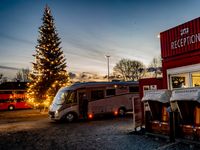
4 Heimathafen Heilsarmee St. Pauli, Talstraße 11, 20359 Hamburg (When you turn into Talstraße, you can directly see the "Jesus lives" sign. You can orient yourself there).,. The Mission Team Hamburg is an institution of the Salvation Army in Germany, which operates independently in diaconal work.
The Mission Team maintains a day center in the heart of St. Pauli. Guests can find a small meal and coffee or other drinks, new clothes, or simply a listening ear for their worries.
Stay overnight
A culture and tourism tax is levied for overnight stays, starting on an open-ended scale, depending on the price, at 60 ¢/night. Exemptions are not provided. Further accommodati...
Stay overnight
A culture and tourism tax is levied for overnight stays, starting on an open-ended scale, depending on the price, at 60 ¢/night. Exemptions are not provided. Further accommodati...
Unterkunft
A culture and tourism tax is levied for overnight stays, starting on an open-ended scale, depending on the price, at 60 ¢/night. Exemptions are not provided.
Further accommodations can be found in the travel guides for Hamburg's districts.
Shopping
Also in Hamburg, between Hauptbahnhof and Rathaus, you'll find the usual department stores and chain stores, somewhat larger and nicer than elsewhere. The 2 Mönckebergstraße lea...
Shopping
Also in Hamburg, between Hauptbahnhof and Rathaus, you'll find the usual department stores and chain stores, somewhat larger and nicer than elsewhere. The 2 Mönckebergstraße lea...
Also in Hamburg, between Hauptbahnhof and Rathaus, you'll find the usual department stores and chain stores, somewhat larger and nicer than elsewhere. The 2 Mönckebergstraße leads along numerous shops to the Rathausmarkt.
However, the Hamburg experience comes from strolling and shopping in the arcades, passages, atriums, galleries, and colonnades. The most beautiful ones are in Neustadt behind the Alsterfleet.
What's worth seeing is not limited to the shops' offerings; the architecture and opportunities for dining and drinking are fascinating. The passages are partly designed based on historical, partly on foreign models and connect the old with the new.
This applies particularly to the beautiful neoclassical building of the 24 Alten Post. Also on the decks of the Fleets, restaurants invite you to dine.
Beyond the Rathaus, you'll find exclusive boutiques of well-known fashion houses on Neuen Wall and in the Alsterarkaden. Numerous cafés invite you to linger. You can take a break, for example, in the elegant 3 Alsterhaus or opposite in the Alsterpavillon (Alex).
Those looking for jewelry and design off the beaten path will find numerous small boutiques and designer shops in 4 Wexstraße (extension of Großen Bleichen street in a south-westerly direction) as well as between Fernsehturm and 5 Feldstraße (at Heiliggeistfeld).
In almost all districts, there are weekly markets on all weekdays where traders offer their goods. Shopping beyond the city center
A nice area is also 6 Ottenser Hauptstraße, which branches off from Altonaer Bahnhof. Here you'll find, among other things, the Mercado-Einkaufszentrum; small cafés and bistros in the vicinity invite you to take a break.
In trendy districts like Eppendorf, Winterhude, or Pöseldorf, you can also enjoy excellent strolling and discovering new things. 7 Eppendorfer Baum is one of them. The department store 8 Kaufrausch, with its interwoven and winding rooms, is waiting to be discovered in the Eppendorf residential area.
3 Café Lindtner rewards the search on Eppendorfer Landstraße.
You'll also find what you're looking for on the harbor edge, e.g., at 9 Stilwerk. At Fischmarkt, in a former malt factory, the world of designers is at home. Around 30 shops showcase everything that is elegant and chic. The star is the building; ancient and ultramodern blend together.
In the foyer, lounge music and gastronomy, the harbor right outside, and fish restaurants around the corner. It's similarly elegant and witty in the former tram depot 10 Falkenried. Fischmarkt
The 11 Fischmarkt, Hamburg's best-known market, starts every Sunday morning at five o'clock, in winter at 7 AM. After an all-nighter, head to the Fischmarkt with its market criers. There you can find (almost) everything, including fish. Live music is also available in the Fischauktionshalle.
- Altona, Große Elbstraße opposite the Fischauktionshalle. • S-Bahn + U-Bahn Landungsbrücken with a 10-min. walk, Bus 112 from Altonaer Bahnhof.
Practical information
Just like in all of Germany, the actual crime rate in Hamburg is inversely proportional to the perceived crime rate. While the total number of crimes has been declining for year...
Practical information
Just like in all of Germany, the actual crime rate in Hamburg is inversely proportional to the perceived crime rate. While the total number of crimes has been declining for year...
Safety
Just like in all of Germany, the actual crime rate in Hamburg is inversely proportional to the perceived crime rate. While the total number of crimes has been declining for years, the public's sense of threat is increasing sharply.
A study published in early summer 2006 even found that citizens believed that areas they had never visited and did not plan to visit posed a particularly strong threat.
In principle, the same precautions apply to Hamburg as to all other German areas. Of particular note for tourists is the area around the Reeperbahn, where arguments and physical altercations, sometimes involving knives, occasionally occur late at night on weekends.
For this reason too, the area has one of the highest police densities in Germany.
In the Reeperbahn entertainment district and the adjacent streets, a general weapons ban is in effect, which also includes the Reeperbahn S-Bahn station. The weapons ban prohibits carrying firearms, knives, batons, brass knuckles, baseball bats, stun guns, and all comparable weapons.
This is monitored by the police; any violations found will be reported. The only exceptions to the weapons ban are pepper spray for police officers and employees of security services.
In the U-Bahn, S-Bahn, and A-Bahn (urban rail) and in Metronom trains, there is a general ban on alcohol consumption, with no time restrictions. The alcohol consumption ban prohibits the consumption of alcohol, as well as carrying alcoholic beverages in open containers.
Violations are punishable by a fine of 40 Euros; in repeat cases, the transport companies also reserve the right to issue a ban from their premises. The alcohol ban does not apply to HADAG harbor ferries or DB Regio local trains, as these depart Hamburg towards Schleswig-Holstein.
Hamburg has a well-organized autonomous scene, whose most prominent core is the Rote Flora in the Schanzenviertel. As an uninvolved party, one should avoid demonstrations as much as possible; the autonomous scene is as notorious in this regard as the Hamburg police.
Detailed information on crime is provided by the 2019 Police Crime Statistics.
Health
Hamburg has a very good healthcare system. In Hamburg, you can be sure that the emergency doctor will arrive in less than 10 minutes after being called.
1 University Hospital Hamburg-Eppendorf, Martinistr. 52.,. medical and dental emergency services in Hamburg a list of medical emergency services in Hamburg
The on-call service of the Association of Statutory Health Insurance Physicians can be reached at the nationwide telephone number 116 117. It offers telephone consultation with a doctor, arrangement of a home visit by a doctor, treatment at an emergency practice, and, if necessary, referral to 112.
During usual business hours, there are sufficient pharmacies in Hamburg.
A pharmacy on-call service is also guaranteed in Hamburg.
Connectivity
Connectivity
Communication
Hamburg is relatively expensive and it is not always easy to get in touch with locals. Nevertheless, new contacts can be made quickly in any district, whether in upscale Blankenese or the autonomously influenced Schanzenviertel.
Down-to-earth people are best met in sports clubs or affordable pubs; in summer, the Elbstrand in Övelgönne is a meeting point. The magazine Neustädter is also recommended for newcomers.
Hamburg's area code is uniformly 040. The island of Neuwerk, part of the federal state (exclave), however, has its own: 04721.